So hey everyone, see, we have previously talked about different aspects of smart ring but in today’s article we will know how smart ring works.
What Is a Smart Ring?
A smart ring is an electronic device that differs from other normal or jewelry rings. Smart rings contain various sensors that measure things like blood flow and movement.
The basic purpose of a smart ring is to track our body data. Smart rings count all the things in our body, such as step count, sleep, heart rate, etc.
How Does a Smart Ring Work?
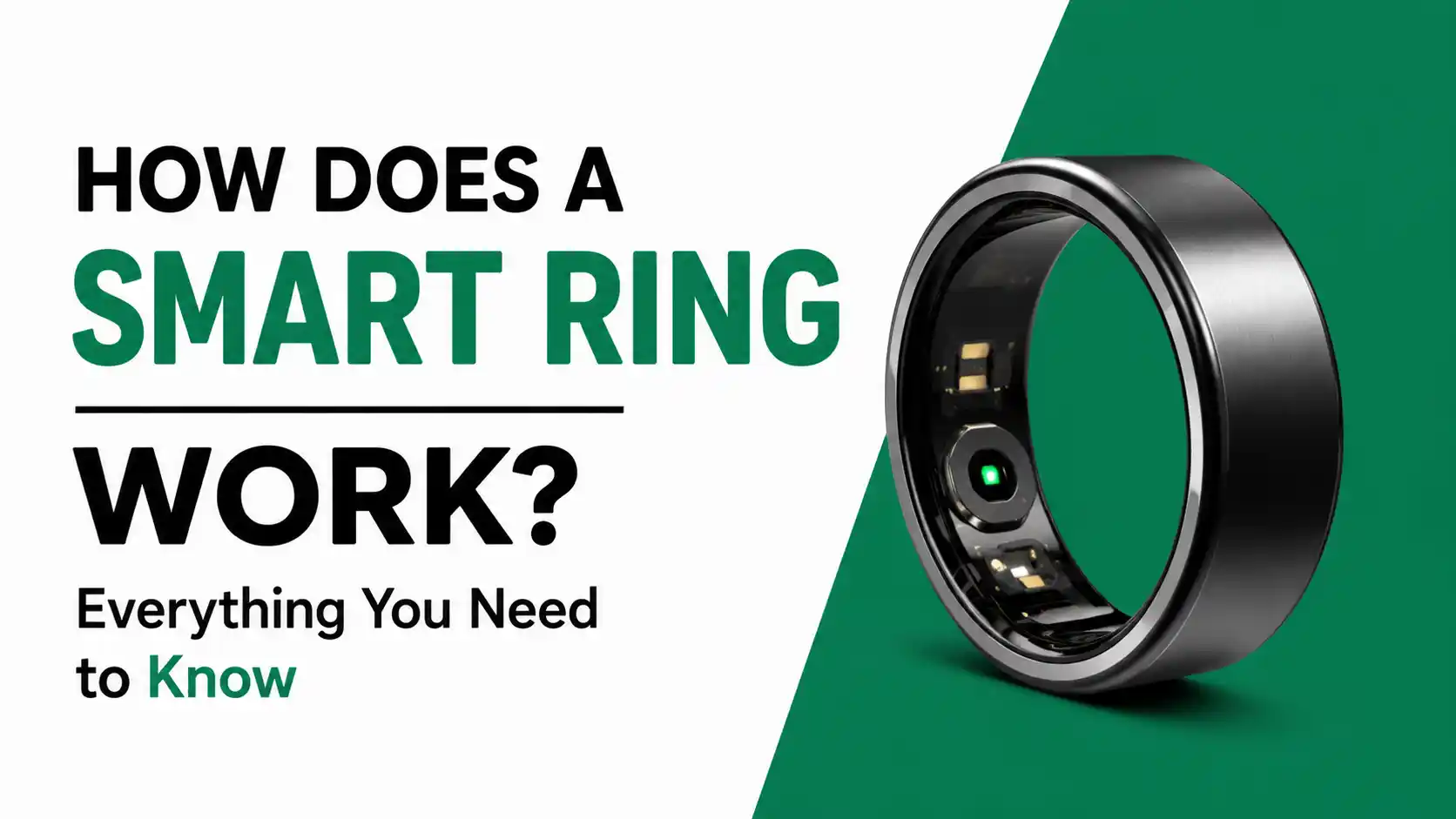
A smart ring is like a computer. It contains sensors that touch the skin, collect data, and then connect to a mobile application via Bluetooth. All the data collected by the smart ring is then displayed in the application.
Regarding the role of the smart ring’s sensors, it basically has three main sensors: PPG sensors, temperature sensors, and an accelerometer.
The PPG sensor emits green and red light. When the light from it touches the skin, it measures heart rate and blood oxygen through blood flow and provides data.
The temperature sensor measures our body temperature and shows us whether it’s hot or cold.
The accelerometer is a sensor that measures how much our hands are moving and how many steps we’ve taken as we walk and move.
The smart ring collects all this data through sensors and then this smart ring gets connected to the smart phone application through Bluetooth and then the smart ring shows all the data on a clear chart in the phone application.
What Sensors Are Used in a Smart Ring?
The smart ring contains various advanced technology sensor chips that measure various aspects of our body. Chips such as heart rate, temperature, motion, blood oxygen, etc. are fitted in the smart ring.
- The heart rate sensor tracks our heart pulse.
- The temperature sensor tells us our body temperature.
- Motion tracks our movements throughout the day and measures our step count.
- Blood oxygen sensor measures the oxygen level in our blood.
The smart ring basically tracks the movements of our body and displays all the data digitally.
How Does a Smart Ring Track Your Heart Rate?
The smart ring measures heart rate using a PPG sensor. It tracks blood flow in our body and tells us about our heart rate.
You can keep tracking your heart rate 24/7. If you wear the smart ring 24/7, then the smart ring fits on your finger, so by staying connected to your skin 24/7, you will be able to measure your heart rate day and night.
The smart ring will collect all the data, and then by connecting it via Bluetooth, you can view the entire data through its application.
How Does a Smart Ring Track Sleep?
The smart ring uses software to measure finger movements and heart rate throughout the night. It then measures these movements throughout the night to create a sleep score.
During sleep, the smart ring tracks heart rate, heart rate variability, movement, skin temperature, and SpO2.
The smart ring tracks light sleep, the nadir at the beginning of sleep, and deep sleep, a phase of physical repair where there is no movement, and heart rate is the lowest during this time. It measures these sleep stages and then displays the data to us.
Also Read: 10 Things to Consider Before Buying a Smart Ring
How Does a Smart Ring Track Your Activity?
Smart rings track our daily activities by measuring our steps, movement, activity, and workouts.
- It tells us how much we walk throughout the day by counting our steps.
- It tracks the movement of our arms and legs to see how much we’ve moved.
- It tracks our daily activities.
- It also measures our workouts.
The smart ring tracks all these activities and displays them on our mobile application, allowing us to improve our daily routines.
How Does a Smart Ring Measure Body Temperature?
The smart ring measures the temperature around the finger. It uses a sensor called an NTC thermistor. The sensor measures the temperature every few minutes and then displays the data.
Skin temperature is essentially the temperature of the skin, not the body’s internal temperature. It changes depending on the external temperature, air temperature, and blood flow. This releases heat from within the body.
The thermistor in the smart ring continuously measures the temperature based on changes in temperature. The smart ring collects all this data after measuring it and then sends it to a mobile application.
How Does a Smart Ring Connect to Your Phone?
Smart rings contain a chip that connects the smart ring to a mobile app. Different smart ring brands create different applications for their own purposes.
Smart rings collect data about our actions and then display it in the mobile app.
How Does a Smart Ring Store and Show Your Data?
The smart ring tracks signals from your body. These signals are collected by tiny sensors. It then sends these signals to your phone, where it displays all the data in a clear chart.
The smart ring contains many small sensors. These sensors track things like heart rate, temperature, sleep, and movement. The smart ring stores all this data for a short time. Then, when your phone is nearby and connected via Bluetooth, it sends all the data to your phone.
Smartphone App Synchronization essentially connects your phone to the smart ring. When your mobile app is turned on, it syncs via Bluetooth. All past data is transferred to the phone and a new number is displayed there.
The smart ring also displays data for Daily, Weekly, and Long-term Trends.
Daily shows your daily data, steps count, movement, and so on. Weekly, it tracks your health for seven days, indicating whether your sleep was adequate. Long-term, it tracks your health monthly to indicate whether your health is improving or deteriorating.
Do Smart Rings Work Without a Phone?
Yes, the Smart Ring works perfectly even without a phone nearby. All the sensors work properly. Heart rate, temperature, and movement sensors all work properly.
The Smart Ring can store activity data in its internal memory for several days even without a phone.
However, since it lacks a digital big screen, you can’t view the data.
Wrapped Up
So, overall, in today’s article, we looked at the function of a device. What all it has, its sensors, and how it all works. So that’s all for today. See you soon with a new topic in another article.